
 USD
USD GBP
GBP EUR
EUR CAD
CAD AUD
AUD ZAR
ZAR
The Accidental Bookseller
Specializing in Uncommon Copies of Interesting Books
Membership(s): IOBA, FABA
We have a small, select stock with focus areas in signed books; modern first editions & poetry; economics; American history; and scholarly books. We are located in Boca Raton, South Florida. If you're local or visiting, feel free to make an appointment to view our inventory in person.
-
Presentation Copy to HOFer's Friend & Team Mate

Living the Dream My Life and Basketball
$300.00Little, Brown & Co.: Boston, 1996. First edition. Signed by Olajuwon and inscribed to his team mate Kenny Smith. Olajuwon and Smith played together on the back-to-back champion Houston Rockets. A stand out center, Olajuwon was a member of the 1994 US Dream Team, was selected as one of the 50 greatest players in NBA history and was named to the NBA 75th Anniversary Team. Fine copy. Dust wrapper with one inch tear to bottom rear else fine. The collaboration between Olajuwon and Smith began on a rocky note with tensions stemming from Smith giving his superstar teammate a bold warning soon after joining the Rockets: “Akeem, if you ever scream at me like you have to other point guards, I will never throw you the ball,” Smith reportedly said. Any teammate who said something like that to the legendary Olajuwon would likely have upset the reigning All-Star. But hearing it from a newly joined player was just too much. Frustrated, “The Dream” responded firmly, saying Smith would continue passing him the ball, no matter what. However, “The Jet” stood his ground, replying with a firm “no.” While this might seem like an audacious move from the former 6’3″ playmaker, Smith actually had a strategic purpose. According to Miriam Fader’s book, he believed he needed to establish his credibility and “gain Olajuwon’s respect” early in their relationship. If one trusts the reports about “The Dream” at the time, this actually seemed like the right approach. After all, the 1994 MVP had a reputation for being overly tough on point guards — a reputation that Kenny had also heard about — with many rumors circulating about Hakeem’s intense interactions with them. Some stories describe him loudly “screaming” at point guards for mistakes, even demanding coaches “take them out on the spot.”Another account mentions a heated confrontation with teammate Vernon Maxwell. Smith, in his mid-20s at the time, wanted to stop such behavior in its tracks, so he decided to make the team’s superstar aware of his boundaries early on. Sometimes, for a relationship to truly break through, it first needs to hit a rough patch — and this perfectly describes the Olajuwon-Smith partnership. This is evident because, after their initial conflict, they went on to develop a strong bond. It all began with Smith gradually making an effort to connect with the former Houston Cougar. For instance, during bus rides, he noticed the seat next to Hakeem was always empty, so he started sitting there regularly to chat with the big man. One memorable trip, the two-time blocks leader shared a heartfelt moment, saying, ‘Kenny, you know you’re the first person that sits next to me and talks to me?'” As a gesture of gratitude, Hakeem invited his new seat neighbor to break bread at his home. Smith accepted, brought his brother along, and the group enjoyed a fish dish prepared by “The Dream” himself. During that dinner, Hakeem shared his decision to recommit to Islam, and “The Jet” felt honored to be welcomed not only into his teammate’s home but also into his personal life. (Julian Eschenbach, Basketball Network, Jan 25 2025)
Offered for Sale by: The Accidental Bookseller -
Signed by gourmet and prolific writer about wine
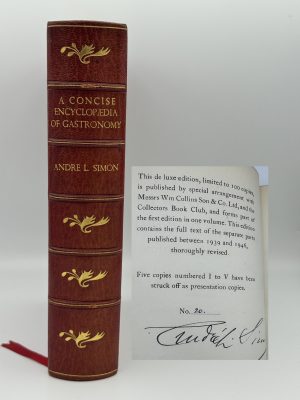
A Concise Encyclopaedia of Gastronomy
$300.00London: Collector’s Book Club, 1952. Limited edition, number 20 of 100 copies signed by the author. Bound in full red Morocco, top edge gilt, 5 raised bands, 4 gilt decorated compartments, author and title in gilt. Bookseller’s small label (harkening back to the days of NYC’s famed Fourth Avenue books district), few stray marks to front pastedown, front hinge starting. Leather with minimal rubbing. Overall, a vibrant near fine copy.
Offered for Sale by: The Accidental Bookseller -
Signed by winner of much coveted Israel Prize
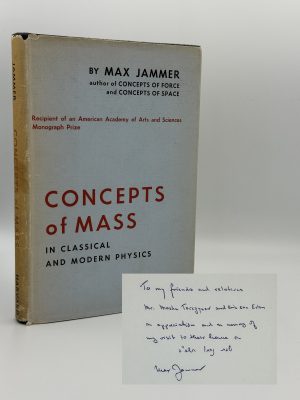
Concepts of Mass
$225.00Harvard University Press: Cambridge (MA), 1961. First edition. Inscribed by Jammer: “To my friends and relatives / Mr. Moshe Torczyner and his son Evan, / in appreciation and in memory of / my visit to their home on (in Hebrew) 11 Iyar 5722” (May 15, 1962). A nice, near fine copy in very good dust wrapper, spine toned and lightly chipped on extremities. An uncommon signature; as of this writing, there are no other books signed by Jammer listed for sale.
Offered for Sale by: The Accidental Bookseller -
Images from the first decade of Ritts' work
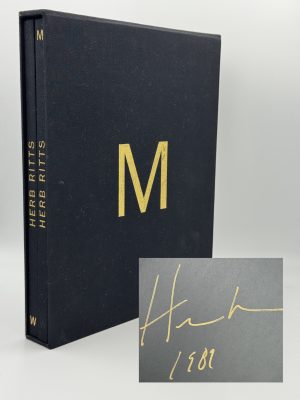
Men / Women
$225.00Los Angeles: Twin Palms Publishers, 1989. Two volumes. First edition, limited to 5000 sets. Though not called for, signed and dated in the year of publication in gold marker by Ritts to the front free endpaper of the Men volume. Fine in publisher’s slipcase with no dust jacket as issued. From the publisher: “This boxed set of two books contains images selected by Herb Ritts from the first decade of his work in photography. Taken for his own pleasure, many of these pictures were rejected for publication in popular magazines which judged them either too eccentric or erotic for their readers. The pleasure of the artist at work is felt in these photographs, which do not compromise the artist’s individual vision for the sake of popular acceptance. The beautiful men and women who populate these pages are familiar for their work in commercial modeling, but Herb Ritts’ camera shows them in a new and familiar light.”
Offered for Sale by: The Accidental Bookseller -
Signed UK (True) First Edition Without Inscription

Genes, Girls and Gamow
$400.00Oxford University Press: Oxford (UK), 2001. The true first edition, preceding the US edition published by Knopf later that year. Signed by the author, a Nobel Laureate for the discovery (along with Francis Crick) of the structure of DNA. Spine a little leaning, minor bump to top front board and one corner, otherwise nearly fine in very good or better dust wrapper, slightly edgeworn and with one minor snag. While signed copies of the US edition are not uncommon, signed copies of the UK first are difficult to find — even more so without an inscription.
Offered for Sale by: The Accidental Bookseller -
Signed Presentation Copy to Author's Sister In La
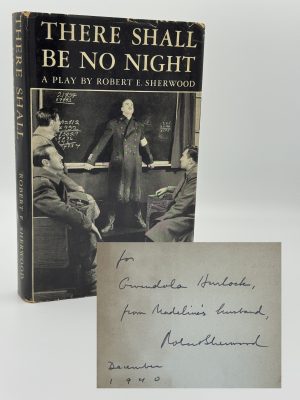
There Shall Be No Night
$425.00New York: Charles Scribner’s Sons, 1940. First edition with Scribner’s “A”. Winner of 1941 Pulitzer Prize for Drama, a play about Finland’s invasion by the Soviet Union. A signed presentation copy inscribed “from Madeline’s husband” to Gwendola Hurlock, sister of the book’s dedicatee and Sherwood’s wife, Madeline Hurlock, a silent film actress. Dated December, 1940. Spine leaning, tanning to front and rear gutters, brief marks to the rear board — a solid very good or better copy in a very good rubbed dust wrapper with a few small, shallow chips.
Offered for Sale by: The Accidental Bookseller -
Diane di Prima's Copy with Orig. Drawing by Dunca
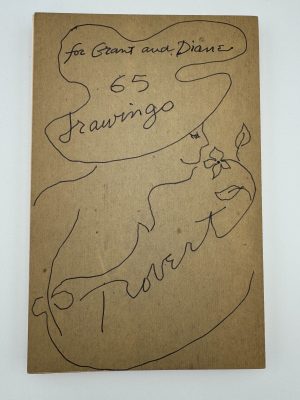
A Selection of 65 Drawings from one drawing book 1952-1956
$400.00Black Sparrow Press: Los Angeles, 1970. 65 loose prints, not bound (as issued). A signed presentation copy from Duncan to Diane di Prima and her second husband Grant (Fisher), with a full page original drawing on card stock, measuring 6″ X 9″, in the style of drawings from the book. The Black Sparrow Press item appeared with a publisher’s chemise and signed colophon page — these are not present here and presumably weren’t included in the author’s copies of the book. A few minor age spots to card stock, otherwise fine. When speaking of the impact of Duncan’s teachings, di Prima cited the lesson that poetry intensifies life. In an interview with fellow Beat poet David Meltzer, she recalled, “Robert was probably one of the closest, most intimate lovers I ever had, even though we never had a physical relationship. I learned a lot of different kinds of things from him. One of the things I learned—in a way no teacher of Buddhism ever showed me—was how precious my life was. How precious the whole ambience of the time. A real sense of appreciating every minute.” di Prima recalled their personal relationship in an August 2001 interview with poet David Hadbawnik: “Robert used to come and hang for days, he’d move into my house in Marshall in the ’70s, and bring his French mysteries that he was teaching himself idiomatic French from, and his notebook, and he’d stay for days. And he always came to Christmases with the kids, because Jess doesn’t like holidays, and so I’d have to say mid-’70s, through ’75 on, he was there many weekends, many mornings…. Eating fried herring from the bay for breakfast.”
Offered for Sale by: The Accidental Bookseller -
Artist's Copy, Inscribed and Signed 6X by Baskin
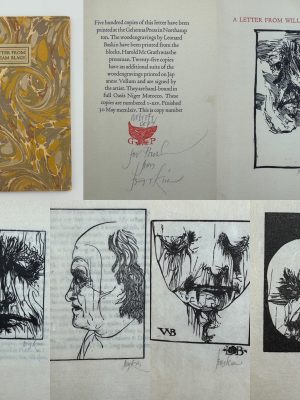
A Letter from William Blake
$500.00Northampton (MA): Gehenna Press, 1964. Limited edition 500 copies. This copy unnumbered but is the artist’s copy, so marked in pencil by Baskin, inscribed by Baskin for Paul (Bitter), Baskin’s nephew (son of Baskin’s then wife Esther’s sister, Fannie). 16 unnumbered pages. With 6 wood-engravings, 4 printed on Japan tissue, all being versions of Blake’s face. Baskin has additionally signed 5 of the engravings, including all the ones on Japan tissue. Original marbled wrappers, printed label on upper cover. Light edgewear as is common to this title, Bitter’s name label, which establishes provenance but is otherwise less than attractive, on front flap. A very good copy.
Offered for Sale by: The Accidental Bookseller -
With an original drawing by Snyder
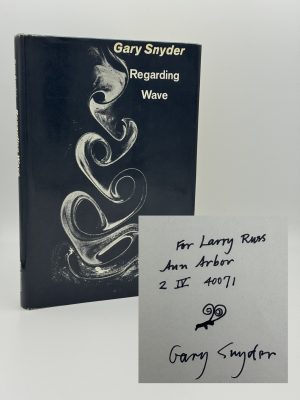
Regarding Wave
$350.00New Directions: New York, 1970. First edition. Signed, located and dated in the year following publication, inscribed to the leader of the student-run Writer in Residence program at University of Michigan at Ann Arbor. Snyder has also added an original drawing of a small animal. Offsetting from laid in newsprint to title and opposite page, scant edgewear to spine tips, small spot top front board, otherwise a fine, tight and unread copy in fine, priced dust wrapper. A very fresh copy.
Offered for Sale by: The Accidental Bookseller -
Signed by six members of the 1950 "Whiz Kids"
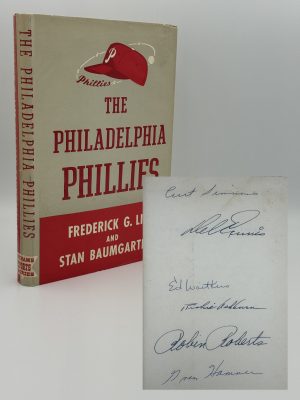
The Philadelphia Phillies.
$500.00G. P. Putnam’s Sons: New York (1953). First edition. Part of the “Putnam Sports Series”. Signed by six members of the “Whiz Kids”, the 1950 Phillies team which, despite a number of young players, unexpectedly won the National League pennant before losing the World Series to the Yankees. Players and their 1950 statistics are: Robin Roberts, elected to the Hall of Fame in 1976, winner of 20-games with a 3.02 ERA Richie Ashburn, Hall of Fame Center Fielder and two-time National League batting leader, hit .303 Del Ennis, Right Fielder who had more RBI than any player other than Stan Musial from 1949-1957, led the team with a .311 batting average, 31 home runs and 126 RBI Curt Simmons, starting pitcher who went 17-8 with a 3.40 ERA Eddie Waitkus, starting First Baseman, .284 batting average Granny Hamner, .starting Shortstop, 270 batting average, 70 RBI Mild toning to endpapers and pastedowns, a solid near fine copy in like dust wrapper
Offered for Sale by: The Accidental Bookseller -
A "stopper" for Denis Johnson completists

Inner Weather
$1,250.00Port Townsend: Graywolf Press, (1976). First Edition. Limited edition, #9 of only 20 copies, signed by Johnson. The very scarce hardbound edition, simultaneously issued with 600 unsigned copies in wrappers. Johnson’s second book of poetry, published seven years before his first novel. An early publication from the author of Jesus’ Son and the National Book Award winning Tree of Smoke. Nearly fine with slight softening to corners without dust wrapper as issued.
Offered for Sale by: The Accidental Bookseller -
Hicks' First Book with ALS to Fellow Economist
The Theory of Wages
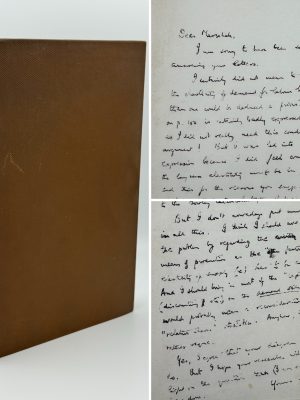
$6,750.00London: Macmillan & Company, 1932. First edition of Hicks’ first book, an attempt at a careful and complete restatement of the marginal productivity theory. In the book, Hicks developed the microeconomics of wage determination in competitive and regulated labor markets. This work also introduced the famous concept of “elasticity of substitution” between capital and labor, which became his basis to dispute Karl Marx’s theory by arguing that labor-saving technological progress does not necessarily reduce labor’s share of income. The book became a standard textbook on labor economics for decades. Pasted in to rear is an autograph letter signed by Hicks to fellow economist Jacob Marschak. Circa 250 words over two-pages. Dear Marschak, I am sorry to have been so long before answering your letters. I certainly did not mean to imply that the elasticity of demand for labour being greater than one would be deemed a priori. The note on p. 100 is certainly badly expressed, especially as I did not really need this condition for my argument! But I was led into certain expression because I did feel convinced that the long run elasticity must be in fact > 1; and this for the reasons you suspect. I could not believe that the elasticity of supply of the other factors (long-period elasticities gains) were likely to be very negative – I should on the whole expect that their curves won’t be far from zero; and if this is so, the <mathematical expression> formula gives what seems a quite impossibly low value for σ if λ < 1. (This with a view to the Bowley calculation.) But I don’t nowadays put much confidence in all this. I think I should now approach the problem by regarding the <illegible> non-labour means of production as the “<illegible> factors whose elasticity of supply (ε), has to be considered. And I should bring in most of the “capital” complications (discovery, etc.) on the demand side. But this would probably mean a reconsideration of the “relative share” statistics. Anyway it is all rather vague. Yes, I agree that your diagram will <illegible> do. But I hope your research will throw more light on the question than (I am sure) mine has done. Autographed material from John Hicks is quite rare, and none of his letters, and few signed books, appear in book auction records. A very good copy lacking the scarce dust wrapper, spine tips rubbed, foxing to side of text block, weakness to the hinge between pages 96 & 97, and bookseller’s label from B. H. Blackwell of Oxford (Marschak, it should be noted, held positions at Oxford from 1930 – 1939). John R. Hicks received the Nobel Memorial Prize in Economic Sciences (jointly with Kenneth J. Arrow) in 1972 for his pioneering contributions to general equilibrium theory and welfare theory. One of the most important and influential economists of the twentieth century, the trail of the eternally eclectic John Richard Hicks is found all over economic theory. Hicks made major contributions to many areas of 20th-century economics; four, in particular, stand out. First, he showed that, contrary to what Karl Marx had believed, labor-saving technological progress does not necessarily reduce labor’s share of the income. Second, he devised a diagram—the IS-LM diagram—that graphically depicts John M. Keynes’s conclusion that an economy can be in equilibrium with less-than-full employment. Third, through his book Value and Capital (1939), Hicks showed that much of what economists believe about value theory (the theory about why goods have value) can be reached without the assumption that utility is measurable. Fourth, he came up with a way to judge the impact of changes in government policy. He proposed a compensation test that could compare the losses for the losers with the gains for the winners. If those who gain could, in principle, compensate those who lose—even if they do not actually and directly compensate them—then, claimed Hicks, the change in policy would be efficient. “How is one to assess an economist whose legacy runs as wide and deep as that of John Hicks? The quintessential ‘economist’s economist’, Hicks cannot be said to have founded a ‘school’ – unless one were to count the generation of eclectic and critical Neo-Walrasian theorists inspired by his visionary but careful work, such as Morishima, Hahn and Negishi. But Hicks was for the most part a lone thinker, part of every school and thus part of no school. If any, his school was ‘economics’. Hicks himself claimed to have created no new economics but simply to have spent his life understanding, formulating and channeling the ideas of the Continental and Keynesian schools and his own historical, philosophical and practical reflections. In a sense, he may have been right – but he analyzed and extended them in a meaningful and challenging way and thus transformed economics in the process. In many ways, Hicks’s scholarly output is a perfect demonstration of how economics should be done: without partisanship for pet theories, without ideological quibbling, his own strictest critic, learning from all and everywhere, constantly searching for new ideas and staying glued to none. Hicks’s approach to economics was informed by all the best qualities of the scientist, poet, philosopher and practical man, and he let none of these tendencies overreach themselves and overwhelm any other. In this sense, no economist before or since Hicks, has achieved such ‘Olympian’ scholarship.” (The History of Economic Thought) The book is annotated in pencil, presumably by Marschak, with the summary “Assuming truth’s and half-truth’s with equal self confidence” written to the front free end paper. Jacob Marschak was an “important developer of economics information theory and a contributor to the early study of econometrics…Marschak’s major work was done in an obscure but important area of conceptual economic theory helping develop methodology for mathematical problem solving” (NY Times obituary). Not mentioned – because not known at the time – is that three of Marschak’s doctoral students went on to win the Nobel Prize for Economics: Leonid Hurwicz (2007), Harry Markowitz (1990) and Franco Modigliani (1985). Marschak was impressed by the need for quantification of economics. His 1931 paper on the elasticity of demand was a landmark in econometric analysis, and as head of the Cowles Commission from 1943 – 1948, Marschak can be given credit for getting the ball rolling for the development of Neo-Walrasian economics and econometrics in the post-war era. Marschak’s contributions to economic theory in this phase were dominated by his interest in the concept of uncertainty. Already in his classic 1938 papers (one with Helen Makower) on monetary theory, Marschak set down the basic ideas for portfolio theory, in which risk was acknowledged to play a role. His encounter with the work of John von Nemann and Oskar Morgenstern (1944) led him to write his famous 1950 exposition of the axiomatization of choice under uncertainty, when he introduced the infamous “independence axiom”. It was specifically in the theory of information, the theory of “teams” and decentralized organizations where Marschak was to make his name (1954, 1968, 1971, 1972). He is renowned for having developed the theory of stochastic design as a way of statistically measuring demand. It was Marschak who helped introduce modern information theory into economics via Shannon’s formalization of information via the mathematical theory of communication. Kenneth J. Arrow, himself a Nobelist, wrote “Marschak became a leader of research organizations at a relatively young age in Germany, and later—with his increasing recognition—was director of the Oxford Institute of Statistics (1935-1939) and of the Cowles Commission for Research in Economics at The University of Chicago (1943-1948)—a fertile period that greatly influenced the course of economic analysis in several diverse fields. Only after 1948 did he begin to make the contributions to economic analysis that are most distinctively his own. Yet in curious ways, the subject matter of his later studies was consonant with his earlier career. An organizer of economic research, he became a theorist of organization. A student and critic of new developments in economic analysis, he developed the economics of information. A skeptic distrustful of received dogma, he studied the economics of uncertainty. Another characteristic of Marschak’s work was his consistently interdisciplinary approach. Some of his early papers dealt with class structure and the emerging phenomenon of Italian fascism. From 1928 to about 1953, though his titles stayed more narrowly within the field of economics as it was then understood, the papers themselves not infrequently contained broader notions derived from politics, sociology, and—later—individual psychology. His work on information and organization, for example, led to a series of experimental and theoretical studies on the psychology of decision making, while during his last fifteen years he organized an interdisciplinary behavioral sciences seminar that proved a main source of contact among mathematical modelers with widely divergent interests.”
Offered for Sale by: The Accidental Bookseller